
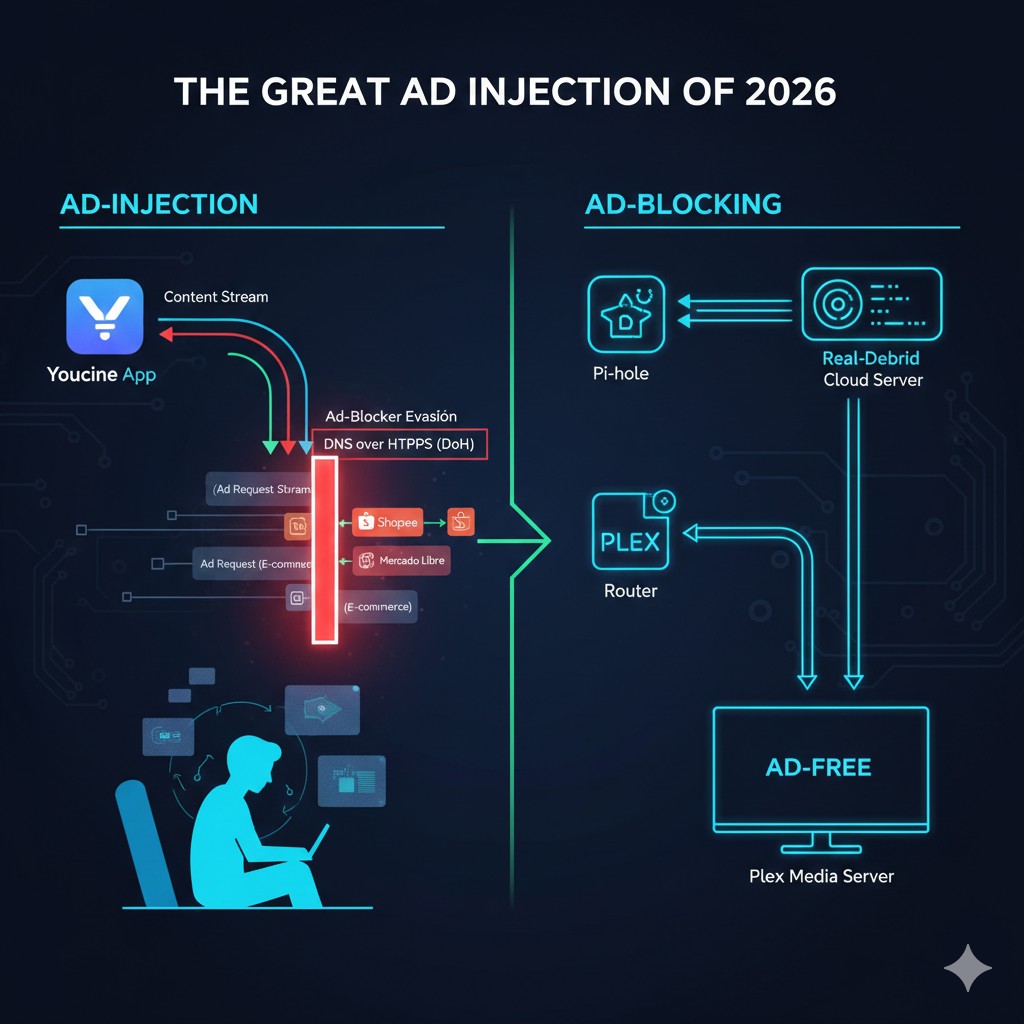
The landscape of "free" or quasi-free streaming applications, such as Youcine and Unitv, has fundamentally shifted in early 2026. Users are now reporting an unprecedented surge in intrusive advertisements, often interrupting content, locking playback, and degrading the overall viewing experience. This is not a mere annoyance; it represents a critical pivot in these platforms' operational models and introduces new vectors of **digital risk**.
The Economic & Regulatory Imperatives Driving Ad-Injection
The proliferation of ads within these traditionally ad-light services is a multifaceted issue driven by escalating operational costs and increased regulatory scrutiny:
- Exponential Infrastructure Costs: Maintaining a global content delivery network (CDN) for high-definition and 4K streaming demands immense bandwidth and server capacity, a cost that can no longer be sustained by minimal VIP subscriptions or donations.
- Intensified Pressure from Rights Holders: Global anti-piracy efforts have made it increasingly difficult for these platforms to operate discreetly, leading to higher legal and operational overheads that necessitate aggressive monetization strategies.
- Erosion of "Shared Account" Revenue: The implementation of IP-based tracking and account sharing restrictions, mirroring established services like Netflix, has curtailed the revenue generated from shared VIP subscriptions, forcing a broader advertising model.
- Hardware Ecosystem Lockdowns: With major platforms like Amazon and Google actively restricting sideloading capabilities, these apps face mounting development costs to circumvent new OS architectures, further pushing them towards ad revenue.
The Technical Evolution of Ad-Injection: Beyond Simple Banners
Today's ad-injection methods are far more sophisticated than previous iterations. Users are experiencing:
SDK-Integrated Ad Delivery (In-App Ad Networks)
Modern applications leverage robust **Ad SDKs (Software Development Kits)** that embed advertising code directly into the app's core. This allows for:
- Non-Skippable Pre-Roll & Mid-Rolls: Ads are served before or during content, often with timers that prevent skipping.
- Overlay Ads: Banners or pop-ups that appear over video content, sometimes requiring user interaction to dismiss.
- Targeted Advertising: These SDKs collect user data (device ID, IP, app usage) to serve highly personalized and therefore more lucrative ads.
Server-Side Ad Insertion (SSAI) - The Future Threat
Some platforms are already testing SSAI, where advertisements are stitched directly into the video stream on the server side. This is a critical development because:
- Ad Blockers are Ineffective: SSAI makes ads indistinguishable from the main content stream to traditional ad blockers, rendering DNS-level blocking largely futile.
- Seamless but Intrusive: While technically "seamless," the user experience is fundamentally altered without any control over ad frequency or duration.
Mitigation Strategies: Reclaiming Your Ad-Free Experience
For users seeking to restore an uninterrupted streaming experience, several technical and strategic approaches are available, each with its own advantages and limitations:
1. Network-Level Ad Blocking (Pi-hole / NextDNS)
Implementing a **DNS-based ad blocker** at the router level (e.g., using a **Pi-hole** or a service like **NextDNS**) offers a robust solution. This prevents your devices from resolving the domain names of known ad servers, effectively blocking ads before they ever reach your streaming application.
- Advantages: Blocks ads across all devices on your network; often effective against many SDK-based ads.
- Limitations: Requires technical setup; ineffective against Server-Side Ad Insertion (SSAI).
2. Premium VPN Services with Integrated Threat Protection
Select VPN providers (e.g., NordVPN's Threat Protection, Surfshark's CleanWeb) now offer integrated ad and malware blocking. By routing your traffic through their secure servers, these services can filter out known ad domains and trackers.
- Advantages: Enhances privacy and security; portable solution across devices.
- Limitations: Subscription cost; potential for minor speed reduction.
3. Transition to Paid "VIP" Subscriptions
While counter-intuitive for users seeking free content, the most direct and guaranteed method to remove ads is often to subscribe to the platform's official VIP or premium tier. This supports the service directly and ensures an ad-free experience, albeit at a cost.
4. Embracing Decentralized & Self-Hosted Solutions (Stremio + Real Debrid, Plex/Jellyfin)
For power users prioritizing control and quality, migrating to a **decentralized streaming ecosystem** is the most future-proof solution:
- Stremio with Real Debrid: This combination leverages cached torrents from high-speed servers. By sourcing content from cached files, users bypass ad-networks embedded in traditional streaming apps. This offers superior quality, minimal buffering, and an entirely ad-free experience for a nominal monthly fee.
- Plex / Jellyfin (Self-Hosted Media Servers): For ultimate control, hosting your own media server allows you to manage your entire content library locally. While requiring initial setup, it provides a completely ad-free, high-quality, and personalized viewing environment.
The Peril of Unofficial "Modded" APKs: A Cybersecurity Warning
The allure of "ad-free modded APKs" for Youcine or Unitv is strong, but the associated cybersecurity risks are substantial. These modified applications, distributed through unofficial channels, often contain:
- Malware & Spyware: Designed to steal personal data, login credentials, or monitor user activity.
- Botnet Integration: Your device can be silently conscripted into a botnet, participating in DDoS attacks or other illicit activities without your knowledge, impacting performance and network security.
- Cryptojackers: Hidden scripts that exploit your device's CPU to mine cryptocurrencies, leading to overheating, decreased performance, and premature hardware failure.
The minimal convenience gained from a "free" modded APK pales in comparison to the significant risks to your digital security and hardware integrity.
Conclusion: The Cost of Digital Autonomy in 2026
The pervasive advertisement within Youcine and Unitv signals a maturing, albeit more restrictive, landscape for free streaming. While immediate solutions exist in network-level blocking and VPNs, the long-term trend points towards increased ad-insertion complexity (SSAI). For true digital autonomy and an uncompromised viewing experience in 2026, users must either embrace paid official tiers or transition to more robust, user-controlled ecosystems like Stremio with Real Debrid or self-hosted media servers. The era of truly free, ad-free, and high-quality "alternative" streaming is rapidly drawing to a close, forcing a re-evaluation of our digital consumption habits.
A Economia da Atenção 2026: Por que seus Dados são o Novo VIP?
Em 2026, plataformas como Youcine e Unitv deixaram de ser apenas hubs de conteúdo para se tornarem gigantes de coleta de dados. A inclusão de anúncios do Mercado Livre e Shopee não é aleatória; ela utiliza o que chamamos de Deep Packet Inspection (DPI) comportamental para entender seu perfil de consumo.
O "Preço Oculto" do Gratuito
Ao visualizar um banner da Shopee enquanto tenta assistir a um jogo, o SDK (Software Development Kit) do anúncio está coletando seu Device ID, localização via IP e até o modelo do seu processador. Esses dados são vendidos em milissegundos em leilões de Real-Time Bidding (RTB) para alimentar algoritmos de recomendação de e-commerce.
Barreiras Técnicas: O que os Ad-Blockers Comuns não Conseguem Deter
Muitos usuários se frustram ao ver que extensões comuns de navegador não funcionam nesses apps. O motivo é técnico: a Ofuscação de Código. Em 2026, os anúncios são camuflados dentro das requisições de sistema do aplicativo, fazendo com que o Android ou o Fire OS entenda a propaganda como uma "função vital" para o vídeo rodar.
O Desafio do DNS Over HTTPS (DoH)
Muitos apps novos agora utilizam DoH. Isso criptografa a requisição de anúncio, impedindo que o seu roteador ou o DNS do AdGuard "leia" o que está passando. Se o roteador não consegue identificar que é um anúncio, ele não pode bloqueá-lo. Isso torna as soluções de nível de rede (como o Pi-hole) uma batalha constante de "gato e rato".
Guia de Infraestrutura Pessoal: A Transição para o Auto-Hospedado
Se você chegou ao limite da paciência com anúncios da Shopee e Mercado Livre, 2026 é o ano para você construir sua própria Nuvem de Mídia. Aqui estão as três colunas da liberdade digital:
| Ferramenta | Função | Nível de Anúncios |
|---|---|---|
| Plex + NAS | Hospedagem de arquivos próprios em hardware local. | Zero (Controle Total) |
| Debrid Services | Streaming direto de links de alta velocidade via nuvem. | Zero (Via API) |
| SmartTube (Open Source) | Cliente alternativo para YouTube com bloqueio nativo. | Zero (SponsorBlock) |
Ética e Segurança: O Risco de Exposição de Credenciais
Ao interagir com anúncios intrusivos dentro de apps de procedência duvidosa, você corre o risco de Clickjacking. O banner pode parecer uma oferta legítima do Mercado Livre, mas o link de destino pode ser uma página de phishing desenhada para capturar sua conta oficial do e-commerce.
A regra de ouro de 2026: Nunca insira dados de login ou realize compras através de navegadores internos de aplicativos de streaming alternativos.
Conclusão: O Veredito do Especialista
O surgimento massivo de anúncios no Youcine e Unitv é o sinal definitivo de que o "almoço grátis" acabou. Para o usuário comum, o Plano VIP é a saída menos trabalhosa. Para o entusiasta de tecnologia, a migração para sistemas Open Source e Debrid é o único caminho para manter a integridade da experiência cinematográfica sem ser interrompido por cupons de frete grátis.